

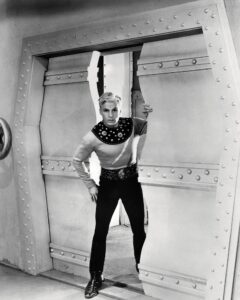
When I was kid I watched Flash Gordon. Not the 1980 version with Sam Jones and the amazing Queen soundtrack, but the original 1930’s Saturday matinee version starring Buster Crabe. In the summertime, TV stations that wanted to do kids-TV on the cheap, would show old serials form yesteryear. But I didn’t mind that it was in Black and White or that it was grainy. This was classic Sci-fi that kept me wanting to see the next episode.
Its not only me who liked these 1930’s serials, a lot of directors got their early ideas from them. Among these was George Lucas, who often credits Buck Rogers and Flash Gordon with inspiring Star Wars. And its easy to see why. Flash Gordon had flying spacecraft with real flames and smoke coming out their engines. Exotic aliens and amazing sets. But what really set them apart was their action and storytelling.
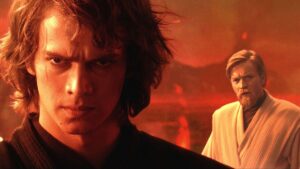
In fact George Lucas is quick to acknowledge the similarities between them and Star Wars, especially when it comes to fending off criticism of one of his prequels, Revenge of the Sith. In Paul Duncan’s book ‘The Star Wars Archives 1999–2005’, Lucas defends the ‘pretty corny’ dialogue that has often been criticized. The director added: “Most people don’t understand the style of Star Wars. They don’t get that there’s an underlying motif that is very much like a 1930s Western or Saturday matinee serial. It’s in the more romantic period of making movies and adventure films. And this film is even more of a melodrama than the others.”
But there are some differences between Star Wars and the serials.
Star Wars does take some things from the early matinees. For example, the famous Star Wars scroll at the start of each film has its heritage in the static one before each episode of Flash Gordon. The purpose in the original serials was to tell cinemas-goers what happened last time. A handy, and necessary service if someone missed last week’s instalment.
And of course the Star Wars movies are presented as episodes, as if we are to watch them as one continuous story. But unlike Star Wars, serials like Flash Gordon began the next episode directly where the previous one ended. The main reason being the ‘cliffhanger’. The famous plot device that showed our hero plunging to their certain death, only to find a miraculous escape at the start of the next episode.
Its even been claimed that Lucas used cliffhangers in the Empire Strikes Back. The movie ends shortly after Luke is told that Vader is his father, plus we don’t know what happened to Han after being frozen in carbonite. But these are hardly cliffhangers in the true sense. If the movie ended with Luke falling from the platform, minus one hand… that would be a cliffhanger. But not only do we see Luke being rescued, we also see him being given a new hand.
The truth is Star Wars isn’t one continuous story. There are gaps, big gaps, and the opening scroll is used to fill in some of what has happened in the intervening years, as if we have All missed an episode or two. I’ve often thought it was a pity that George numbered his episodes as it could have allowed for some of the gaps to be filled in, in future.
 It could be argued the closest Star Wars has come to replicating the cliffhanger and continuous storyline of a serial, is from ‘Rogue One’ to ‘A New Hope’, where we see how the death star plan’s make it on to Princess Leia’s ship, just as its being captured by the Empire and Darth Vadar. (Of course Rogue One was made long after George’s departure from Lucasfilm).
Even with that I would suggest that the 1980 Flash Gordon film is far more in the style of the original. The special effects wouldn’t look out of place 50 years earlier. The acting and script equally so. But, does this detract from the movie?… not in the slightest. It shouldn’t work (especially coming just 3 years after paradigm shifting Star Wars), but it does. Its incredibly entertaining and the actors seem to be having as much fun as the audience. The dialogue, rather than being criticized, has become some of the most memorable in sci-fi history. Whether its Brian Blessed bellowing out ‘Gordon’s alive’ or Melody Anderson proclaiming ‘Flash, I love you! But we only have fourteen hours to save the Earth!’, the dialogue might be corny, but the whole movie is.
The main reason why the Star Wars is fundamentally different from the early serials, is their quality. For all their faults, the original trilogy and the prequels are some of the best Sci-fi movies ever made. Episode IV: A New Hope after 40 years, can still stand up against anything in the cinemas today. By creating a believable universe, full of a myriad of aliens, planets and histories behind all of them, and by taking special effects to the next level, Lucas set his own standard, far above anything that has come before or since.
The reason the ‘corny dialogue’ stands out in many Star Wars movies isn’t because it harks back to a bygone age of Hollywood, its because its just not that good, and doesn’t sit well alongside, what is otherwise, superb film-making.